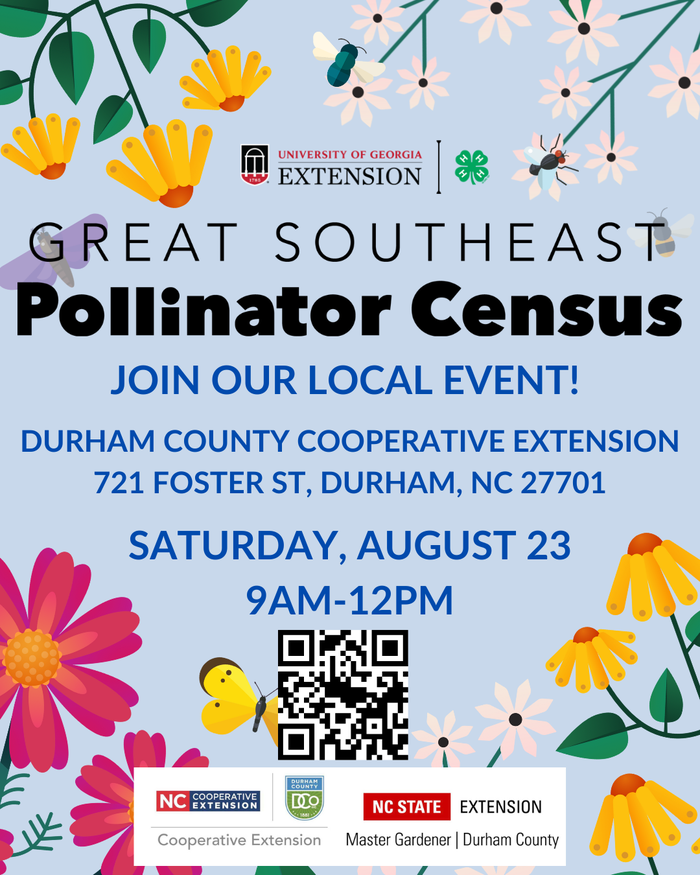
Join us as the Extension Office (721 Foster St, Durham, NC) to participate in the Great Southeast Pollinator Census! The Extension Master Gardener℠ volunteers of Durham County and community partners will be on hand August 23 to share information about pollinators and native plants. Stop by between 9 a.m. and 12 p.m. to learn about pollinators and help us collect pollinator counts!
We will have Vendors, Crafts, Treats, a giveaway, and a special appearance by a local celebrity, and of course tons of fun and games with pollinators.
While we would love to have you join us for our Durham Event, there's plenty you can do at home if you can't make it.
“Pollinators are under threat.” We hear it more and more from scientists and the news. If you haven’t heard, you’ve probably at least noticed that your windshield has stayed a lot cleaner over the last couple of decades. What is important to understand from this is that our survival as humans is linked with insect diversity and survival. How do scientists know insect populations are declining (besides the cleaner windshields)? They count them!
Now, scientists aren’t out there counting each and every one in an ecosystem. That is a Herculean task at least. At any given time there are about 10 quintillion (10,000,000,000,000,000,000) insects on Earth at any given time, according to the Entomological Society of America (ESA). More than 60 percent of the total species in the world are insects, with estimates speculating there are between 3-6 million species left to describe! Needless to say, that is a lot, and scientists need all the help they can get!
How can you help?
Queue the Great Southeast Pollinator Census! This simple citizen science project is an easy gateway for anyone interested in helping scientists. It is only two days each year. This year it is August 23 and 24.
All participants do is observe a plant that has pollinators visiting it for 15 minutes and tally each time an insect lands on the plant using the pre-designed data sheet (available for free download on the Census website). The data sheet has pictures of what each insect is, so you don’t even have to know the names of the insects. Upload your counts to the GSEPC website afterwards using the QR code at the top of the page. It’s just that easy!
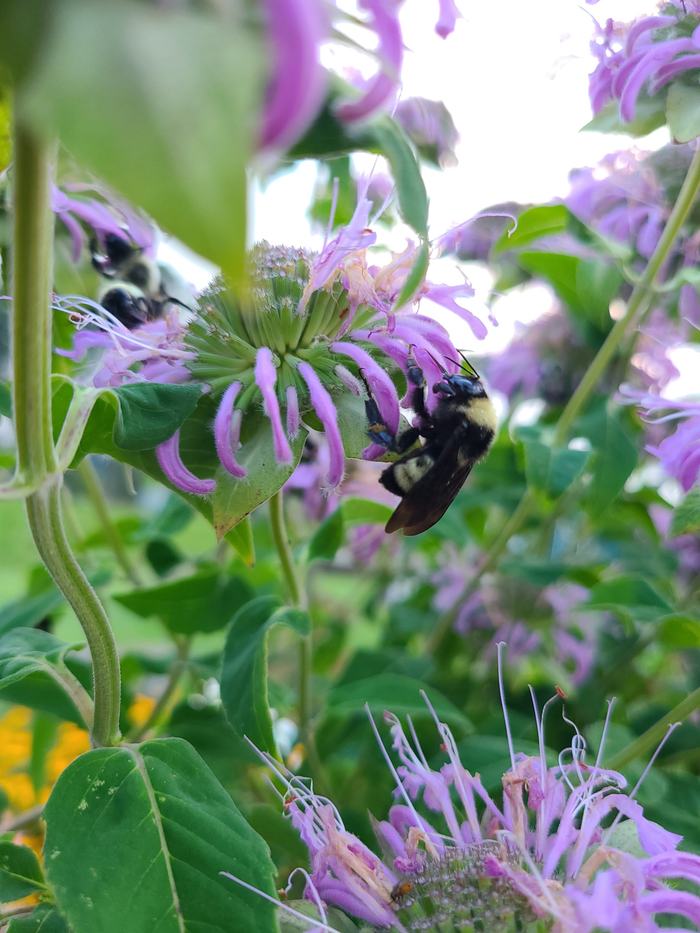
Bombus pennsylvanicus American Bumblebee_Photo by Amanda Wilkins
You can do it anywhere where there is a plant with insects visiting it: your garden, a local park, a nature trail, or a botanical garden. You can take a Census on as many plants as you want within the two-day window.
Where did the Census come from?
The Great Southeast Pollinator Census first came to North Carolina in 2023. Becky Griffin at UGA Extension started the Census in Georgia in 2017 as a pilot program with local community gardens and schools. She realized gardeners were excited to learn about the plants, but were oftentimes oblivious to the insects in their gardens, beyond the ones that were pests. She devised the Census program to raise awareness and literacy around insects in the garden, and to empower everyday citizens to use their powers of observation to gather data for scientific research. The Census website contains the data from past years and the research papers that have been published using those data.We hope you can join us this year by counting insects in this year’s Census. If you have questions about the Census or how you can incorporate the Census into programming with your organization, please contact Ashley Troth at N.C. Cooperative Extension, Durham County Center at
ashley_troth@ncsu.edu.
References
Numbers of Insects – Smithsonian InstituteGreat Southeast Pollinator Census
Pollinator Partnership
Xerces Society Pollinator Conservation in Yards and Gardens Guide
This post is based off content developed by Amanda Wilkins, Extension Agent, Lee County Center.